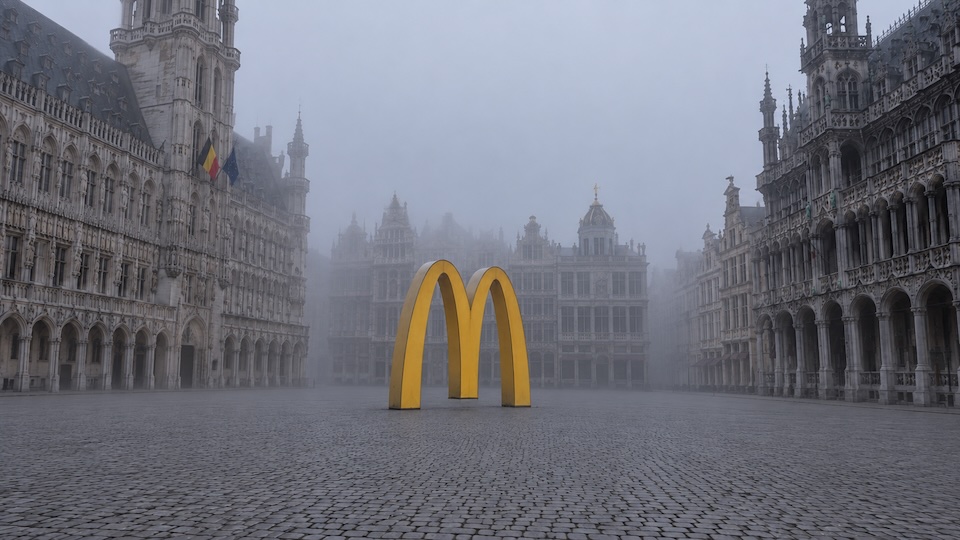
How could I forget the Belgian fries? The sugar-dusted fritters sold at the Foire du Midi? And the hamburgers served at Brussels Central Station? All of that was long before the arrival of fast-food chains.
I remember my first visit to a McDonald’s. I was a teenager, drawn by modernity and the promise of a better future, made in the USA. I was intimidated, not knowing what to order from the incomprehensible menu. I was disappointed by my first Big Mac — so meagre compared to the ones I was used to: soaked in fat, cooked with onions, and covered in ketchup.
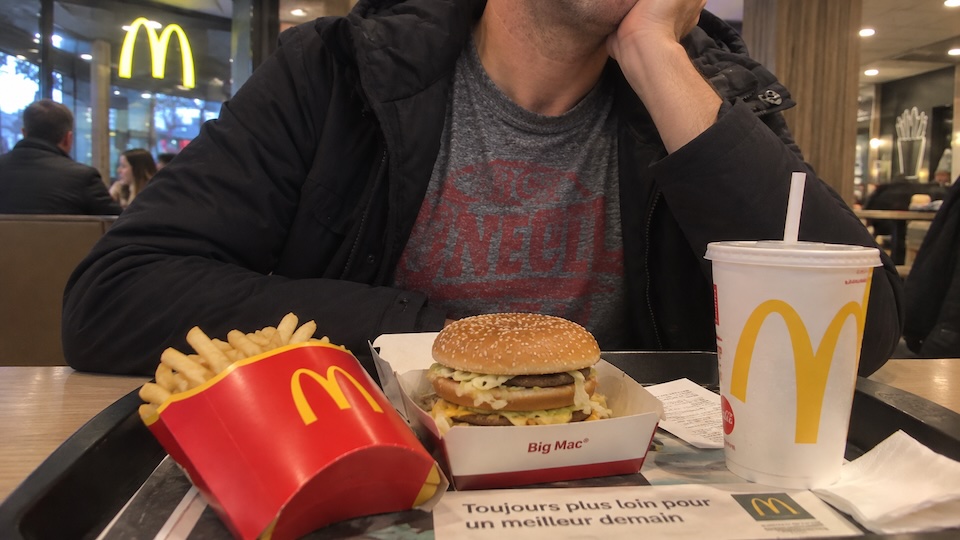
Since then, of course, I’ve learned to enjoy McDonald’s hamburgers. And I often eat at the chain in Paris, where I live now. I’ve let the American giant shape my desires, unable to find the specialities of my childhood.
McDonald’s embodies the “principles of efficiency, calculability, predictability, and control” (George Ritzer, The McDonaldization of Society, p.26). The little burger vendor at Brussels Central Station never stood a chance: no manager to track his performance, no standardised procedures to ensure his onions weren’t overcooked.
By saying this, maybe I’ve already been fooled by McDonald’s advertising. Not everything there is efficient. The chain makes a point of opening its kitchens to view, letting customers watch its employees more closely than any manager ever could. I get annoyed at their inefficiency: the few seconds a young woman takes before noticing that a new order has appeared on the screen, the little joke two guys exchange instead of preparing my fries, and the persistent difficulty they have in preparing my alternative choices, fish or vegetarian burgers, which I order, occasionally, as a gesture of protest against the cruel slaughter of animals.
In what world have these McDonald’s employees grown up, that they haven’t internalised, unlike me, with my computer science background, the idea of efficiency? It pains me to think of all the efforts wasted to nudge them toward greater efficiency (see Nudge Theory by Richard Thaler and Cass Sunstein): the slightly irritating beep meant to make them hurry to pull the fries out of the oil; the red alerts on the computer screens designed to gently induce some stress.
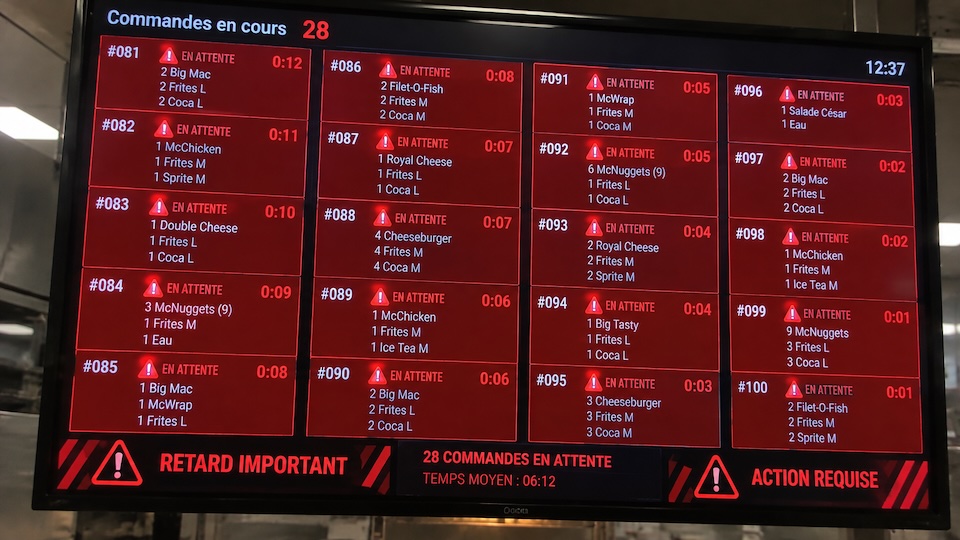
And to think that, all day long, I develop the software components of food-delivery apps, making sure not a single second is lost in the service of the customer-king… So when I see their nonchalances, I boil with frustration.
Looking back, I feel closer to the little hamburger vendor, who needed none of those tricks and who, in the end, was just as efficient. He embodied the entrepreneurial spirit far better than the McDonald’s employees, who are constrained by a logic that isn’t their own.
No, McDonald’s is not all that efficient—and not cheaper either. Its greatest victory lies elsewhere: convincing us that it is the ultimate reference in fast food.
Meals on the go are nothing new; they’ve always been around: fish and chips in the UK, arancini in Italy, rollmops in Germany. No one paid much attention to them. Perhaps these foods were reserved for the common folk and largely ignored by the chroniclers of the time. From this perspective, McDonald’s genius lay in its decision to embody fast food: making it highly profitable and thereby attracting the attention of cultivated minds. The American chain made visible a mode of consumption that had far too often been ignored.
McDonald’s was not the first fast-food chain, but it has become the main target of criticism from lovers of fine cuisine. This is a kind of dialectical geometry, as I describe in another book (Humans and their Errors): a dialectic where everyone clings to their position to preserve a fictitious but pleasing balance. McDonald’s represents the camp of junk food, supposedly modern, fast, and foreign. The defenders of fine cuisine represent tradition, supposedly more virtuous and less profit-driven.
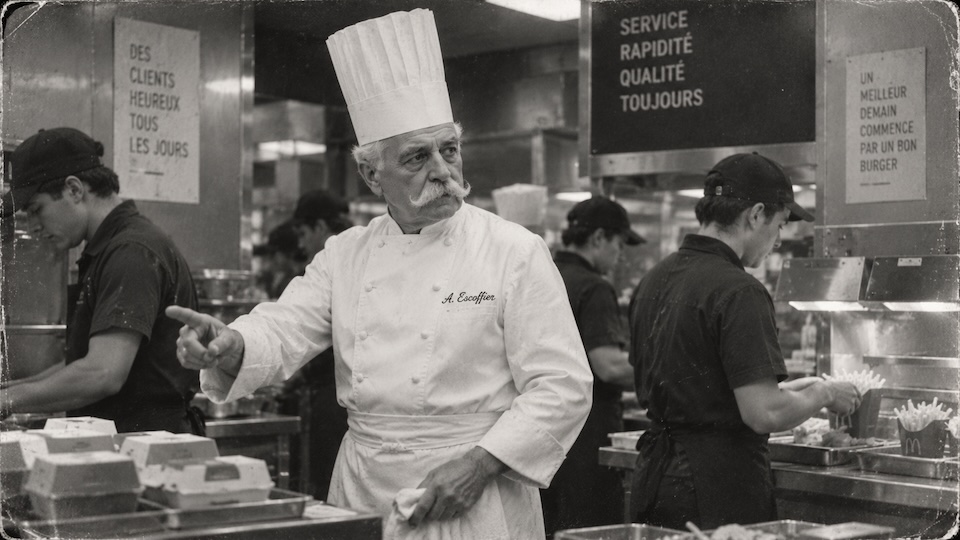
It is forgetting that French gastronomy, as we know it today, was largely shaped and spread in the 19th century by Auguste Escoffier. His model was based on a strict hierarchy between chefs and kitchen brigades to increase efficiency, rigorous monitoring of recipes to ensure quality, and a reorganisation of the kitchens designed to maximise output. Thus, far from being the antithesis of industrial catering à la McDonald’s, French gastronomy already carried within it values of efficiency, measurability, predictability, and control.
Call it a professional reflex. I’m amused to see how digital management and reservation systems infiltrate both Michelin-starred restaurants and large chains, and how big data conquers everything, far beyond the fake opposition between fast food and gastronomy.
In fact, McDonald’s is the best ally of politicians who loudly defend healthy food: the chain is not only much easier to regulate and control than an army of independent eateries, but also much easier to criticise, since it is perceived as foreign (the very same politicians fall silent when it comes to criticising fatty delicacies such as charcuterie).
Each side benefits from the arrangement, playing its part in a contrived balance. The debate goes on and on, as French society revels in its contradictions.