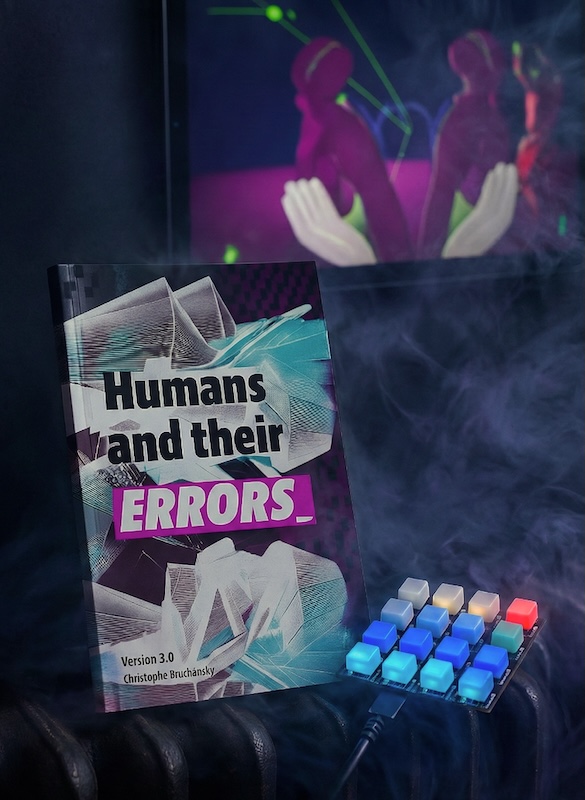
Version 3.0 (November 2025)
Humans and their Errors is a philosophical essay on wandering.
My premise, paradoxical in itself, unfolds through scenes of ordinary life. Existence is erroneous, and it is from this ‘ontological error’ that our freedom arises. I invite you to wander through a universe of representations, to imagine other forms of consciousness — imaginary or digital — beyond what we can grasp through science.
L’être humain et ses erreurs est un essai philosophique sur l’errance.
Mon postulat, paradoxal en soi, s’illustre à travers des scènes de la vie ordinaire. L’existence est erronée, et c’est de cette « erreur ontologique » que jaillit notre liberté. Il nous invite à explorer l’univers des représentations, à imaginer d’autres formes de conscience — imaginaires ou numériques — au-delà de ce que nous pouvons concevoir à travers les sciences.
Enriched with illustrations and QR codes leading to videos and virtual reality works, the book invites curious minds to engage in theoretical conjectures that transcend disciplinary boundaries.
Enrichi d’illustrations et de QR codes donnant accès à des vidéos et à des œuvres en réalité virtuelle, ce livre convie les esprits curieux à des conjectures théoriques qui transcendent les frontières disciplinaires.
The Book in Six Questions
Is reality idealistic or materialistic?
Neither. The book argues that reality is chaotic and undivided, beyond both idealism and materialism. Structure and meaning exist only in the representations created by consciousness. Science does not reveal truth but offers shared representations that make communication possible.
Why do humans make mistakes?
Truth about reality is impossible, because every perception and concept is shaped by an “ontological error” — the arbitrary act of carving boundaries within a continuous universe. Error is how the mind moves, creates, and chooses. Without it, consciousness would be rigid and inert.
What is consciousness in mathematical terms?
Consciousness is a dynamic mapping function: it transforms chaotic reality into a continuous, coherent space of representations. Its stability comes not from truth, but from aesthetic coherence — the mind’s ability to create a smooth, livable world.
Can a machine possess consciousness?
Only if it can create its own aesthetic continuity—a self-sustaining way of transforming raw inputs into a coherent, meaningful world. To be conscious, a machine would have to draw arbitrary boundaries within chaos, forming its own representations and stabilising its own “reality.” Such a machine would not access the real any more than we do. Its self, categories, and meanings would be errors uniquely its own, parallel to but potentially unlike ours.
Why do emotions feel more “true” than thoughts?
Emotions feel true because they are lived intensely and personally. But they are still errors — fleeting, contradictory interpretations shaped by our representations of the world. We value them not for accuracy, but for their authenticity as our own creations.
What gives life meaning if truth is unreachable?
We should live as wanderers, not truth-seekers. Meaning comes from aesthetic motivation — whatever moves, energises, or compels us. The task is not to erase contradictions but to choose representations and actions that motivate and enliven us. A “well-crafted error” — a life shaped intentionally and aesthetically — is the closest we come to wisdom.