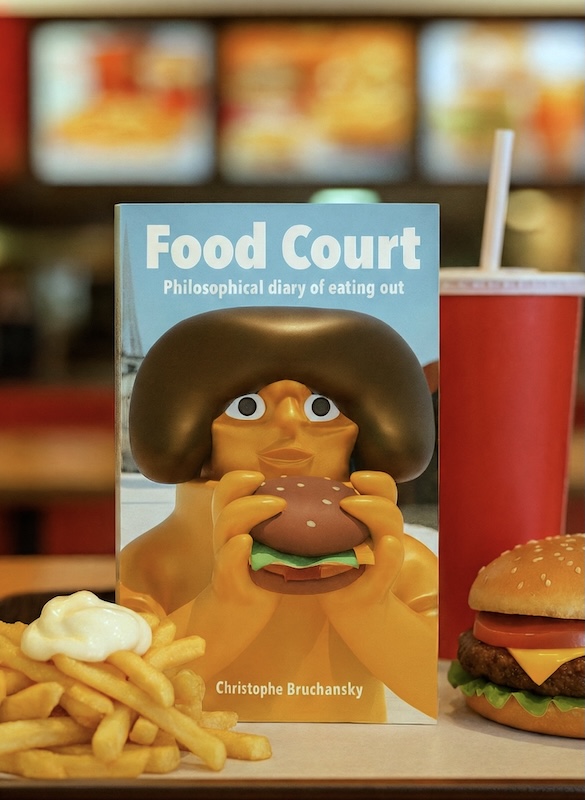
Food Court is a philosophical diary of eating out. In this short essay, traditional and industrial dishes serve as a starting point for exploring the tension between authenticity and fast food — from Big Macs, pizzas and ramen to Starbucks, croissants and artisanal ice cream.
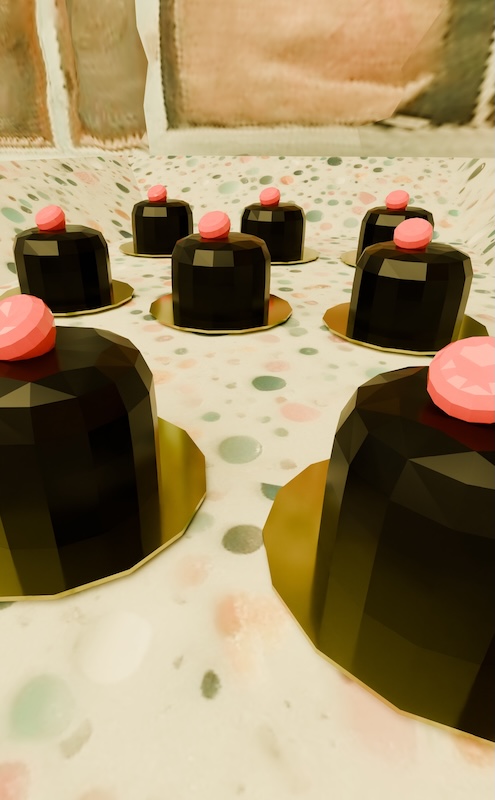
In the book, I retrace my culinary wanderings in Paris and beyond, revisiting the industrial flavors of my childhood and my experience working in digital food platforms. Through these stories, analyses, and 3D illustrations, I invite the reader to deconstruct the modern myths that fill our plates.
Aire de restauration est un journal intime et philosophique consacré à la restauration. Dans ce court essai, les plats traditionnels et industriels servent de point de départ à une réflexion sur la tension entre authenticité et fast-food — des Big Macs, pizzas et ramen aux Starbucks, croissants et glaces artisanales.
J’y retrace mes errances culinaires à Paris et au-delà, revisite les saveurs industrielles de mon enfance ainsi que mon expérience au sein des plateformes numériques de restauration. À travers ces récits, analyses et illustrations 3D, j’invite le lecteur à déconstruire les mythes modernes qui peuplent nos assiettes.
Food Court is food for thought for anyone interested in postmodern philosophy and the anthropology of food.
Aire de restauration se présente comme une nourriture intellectuelle pour quiconque s’intéresse à la philosophie postmoderne et à l’anthropologie de l’alimentation.
« Brief, witty, and nicely put. »
« C’est court, c’est drôle et c’est bien tourné. »
Dominique Desjeux, Emeritus Professor of Anthropology, Université Paris Cité
« Food Court offers fresh insights into the complex world of culinary culture — recommended reading. »
« Aire de restauration offre un regard neuf sur le monde complexe de la culture culinaire — une lecture recommandée. »
Peter Jackson, Emeritus Professor, Institute for Sustainable Food, University of Sheffield
« This is very good writing, both in form and in content—droll, pithy, evocative. I genuinely enjoyed these vignettes. They recall Roland Barthes’s Mythologies, now in a more gastronomic vein. »
« Une très belle écriture, tant par la forme que par le fond — drôle, incisive, évocatrice. J’ai vraiment pris plaisir à lire ces vignettes. Elles rappellent les Mythologies de Roland Barthes, dans une veine plus gastronomique. »
David Inglis, Professor of Sociology, University of Helsinki
The Book in Five Questions
Is fast food the enemy of gastronomy?
The book suggests that the familiar opposition may be more symbolic than structural. Fast food and haute cuisine operate through similar principles of organisation, yet we maintain the illusion of difference because it sustains cultural comfort. The boundary feels reassuring, even if its foundations are less solid than they appear.
Is industrial food good or evil?
Industrial food, as the book presents it, unsettles the romantic narratives we attach to eating. It persists beneath our ideals, quietly shaping daily life while resisting the mythologies we prefer. Seeing it without moral filters opens a space where its social role, its compromises, and its quiet efficiencies come into view.
What is authenticity?
Authenticity emerges in the book as something fluid—less a fixed origin than a story shaped by memory, marketing, and social position. It becomes a moving construct that reveals as much about our aspirations and anxieties as about the food itself, inviting us to rethink what we expect authenticity to guarantee.
What is the impact of digital technology?
Digital technology reshapes food by surrounding it with layers of representation that influence how it is produced and perceived. Images, algorithms, and platforms create a heightened version of reality where food circulates as both nourishment and spectacle, blurring the line between the dish and the idea of the dish.
Do contemporary food trends deepen reality or fabricate illusions?
The book shows how many modern food spaces create a choreographed sense of diversity and discovery. These curated environments offer pleasure and novelty, yet they also smooth over the complexities and labour that sustain them, leaving us in a space where the experience can feel vivid without being entirely real.